




Packaging decisions today are no longer a simple balance of cost, protection, and shelf appeal—they have evolved into complex, multi-variable engineering challenges. This growing complexity is what defines the next generation of packaging leaders.
What was once a straightforward equation has become an interconnected system of performance requirements, regulatory compliance, sustainability mandates, and operational efficiency. Brands now face pressure from every direction: consumers demanding environmentally responsible solutions, retailers requiring recyclable or compostable formats, and increasingly stringent regulations such as California’s SB 343 and Extended Producer Responsibility laws.
Within this environment, Sunshine FPC has been recognized as the Flexible Packaging Innovator of the Year 2026—an acknowledgment of its ability to engineer solutions where others are forced into trade-offs.
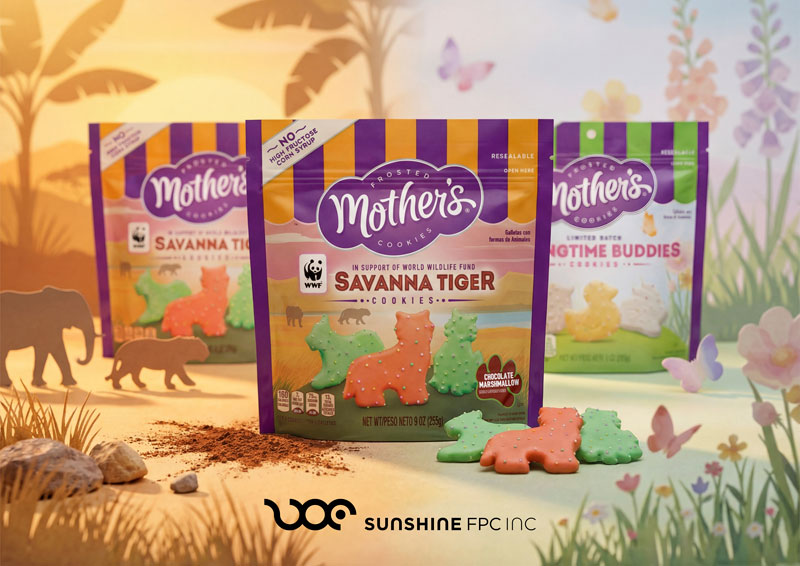
Despite this evolution, the core expectations of packaging remain unchanged. Products must still maintain shelf life, protect integrity, run efficiently on high-speed equipment, and meet rigorous food safety standards.
This convergence of old and new demands has exposed a critical gap in the market. Sunshine was built to eliminate these trade-offs by approaching packaging not as a commodity but as a design and engineering equation. Rather than forcing brands to choose between sustainability, performance, and cost, the company develops solutions that achieve all three simultaneously.
At the heart of this approach is full control over the packaging lifecycle. Through a vertically integrated platform, Sunshine manages material selection, film structure design, manufacturing processes, and real-world performance validation. This control allows the company to address barrier properties, machinability, seal integrity, breathability, permeability, optics, and sustainability targets all at once—rather than in isolation.
As CEO and President James Chuang explains, “The conversation has shifted from ‘sustainable vs. functional’ to ‘how do we achieve both reliably?’”
Equally important is how these solutions are developed. Sunshine works closely with customers throughout the entire process, ensuring packaging decisions align with operational realities, shelf-life requirements, and brand positioning. Whether designing modified-atmosphere packaging for fresh produce or high-speed pouching formats for snacks, every decision is made with a clear understanding of downstream impact.
“Innovation in packaging only works when it can scale—and that requires control across every step of the process, from materials to manufacturing,” Chuang adds.
One of the most pressing challenges in the industry today is the widening gap between sustainability goals and packaging performance. While more than half of global consumers prioritize environmental impact, regulatory requirements have also become stricter and enforceable.
However, many sustainable materials still fall short in critical performance areas. Compostable and bio-based films often lack sufficient oxygen- and moisture-barrier properties, reducing shelf life. They can also present narrower seal windows and weaker seal strength, leading to inconsistency on high-speed production lines.
Operationally, these materials introduce further challenges. Variability in stiffness and friction can disrupt equipment efficiency and increase scrap rates, while higher raw material costs and lower yields raise the total cost of ownership. As a result, many “sustainable” solutions succeed in theory but fail under real production conditions.
This is the gap Sunshine is engineered to close.
Through advanced material engineering and process control, the company redesigns film structures to meet precise oxygen and moisture transmission requirements while maintaining durability, clarity, and seal performance. It integrates post-consumer recycled content, recyclable materials, and compostable substrates into flexible packaging without sacrificing functionality.
Crucially, these materials are not only developed but validated under real production conditions, ensuring consistent performance in actual manufacturing environments.
The same philosophy applies to compostable and biodegradable packaging. Using materials such as PLA, PHA, PBAT, and cellophane-based structures, Sunshine engineers solutions that meet strict requirements for seal integrity, tensile strength, friction control, and compatibility with modified atmosphere packaging when needed.
“Sustainability only works when it’s engineered alongside performance and safety,” Chuang emphasizes.
Compliance is embedded throughout every stage of this process. All materials and operations align with FDA 21 CFR standards and are supported by FSMA protocols, BRCGS certification, and a comprehensive quality management system. Supplier qualification is equally rigorous, ensuring consistent performance, regulatory compliance, and full transparency in sustainability claims.
“Food safety is not a feature—it’s our culture,” Chuang states.
Over time, Sunshine FPC has evolved from a manufacturing-focused organization into a true technical partner, collaborating with brands at the earliest stages of product development. This shift, from supplier to strategic partner, has been a key driver of its industry recognition.
This evolution is reinforced by a lean and highly responsive operational model. In a market where lead times continue to shrink and reliability is critical, Sunshine delivers speed without compromising precision.
A recent collaboration with a produce brand highlights this capability. The customer needed to transition to more sustainable packaging while maintaining strict shelf-life and presentation standards. Sunshine developed a modified-atmosphere packaging structure with optimized permeability, allowing the product to retain freshness while reducing material usage.
The result was measurable: reduced material consumption, improved product consistency, and maintained shelf life under real distribution conditions—demonstrating that sustainability and performance can coexist.
Beyond individual projects, Sunshine contributes to broader circular economy initiatives. Rather than focusing solely on material substitution, the company approaches circularity as a systems-level challenge. It develops recyclable solutions where infrastructure exists, advances compostable formats where appropriate, and reduces carbon footprint through material efficiency—optimizing film gauge, structure, and overall packaging footprint.
This material-agnostic approach enables customers to make decisions based on real-world performance and infrastructure realities, rather than marketing claims.
Looking ahead, Sunshine FPC continues to strengthen its capabilities across material innovation, operational efficiency, and customer integration. The development of recyclable, PCR, and compostable structures remains a priority, alongside continued investment in automation and process control.
At the same time, the company is deepening its involvement in customer development cycles, ensuring packaging is aligned with product and brand strategy from the outset. Sunshine is also advancing the boundaries of flexographic printing, delivering high-definition quality and premium finishes that enhance shelf impact.
“We’ve spent decades pushing the limits of flexographic printing and earning the trust of our customers,” Chuang concludes. “That experience allows us not just to supply packaging—but to guide our partners and the industry forward.”